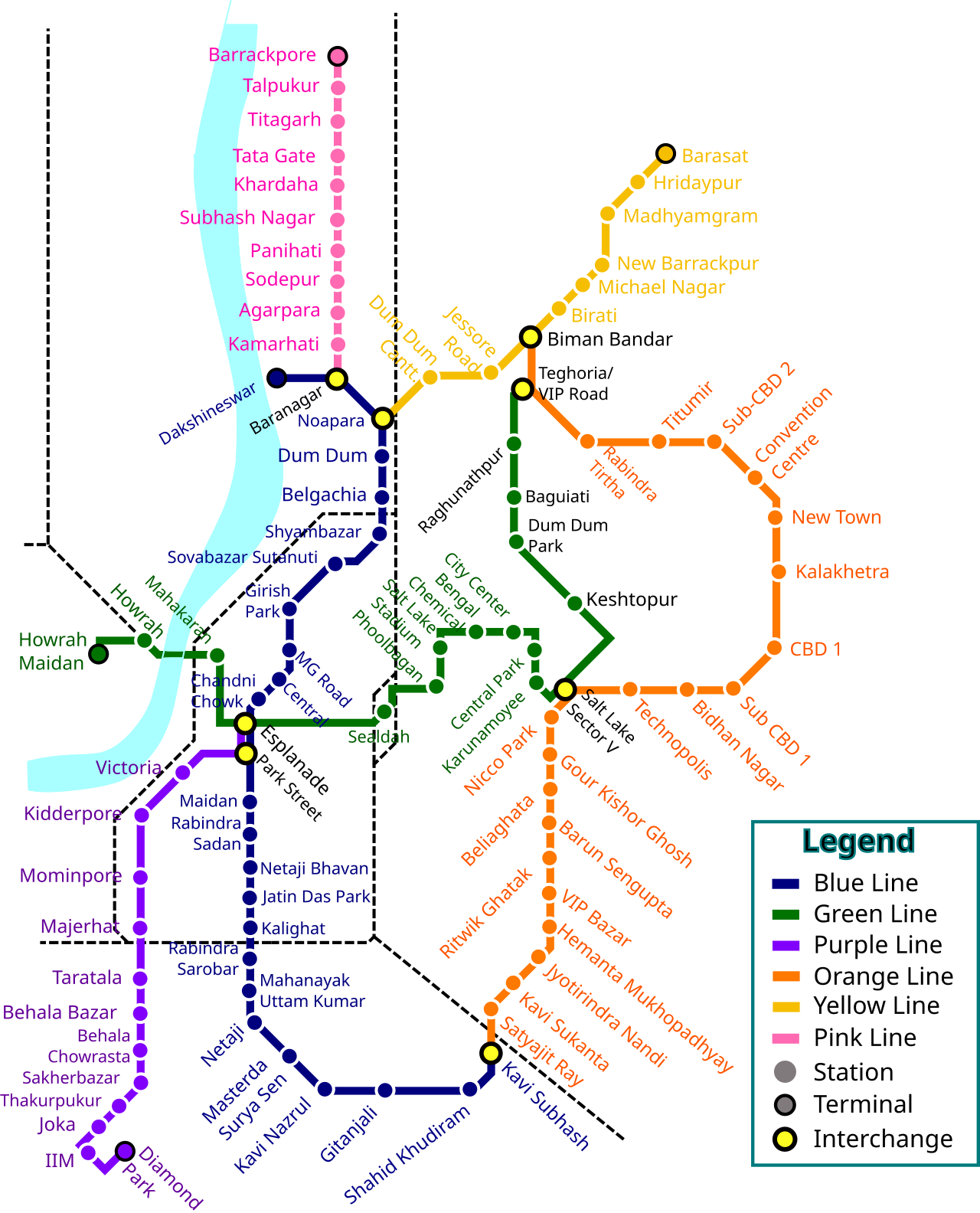
History & Evolution of Kolkata Metro Network
The Kolkata Metro is the oldest mass rapid transit system in India, with its first commercial service commencing on 24 October 1984. Built initially under the aegis of Indian Railways, the network has expanded significantly. The latest addition is the East-West Green Line which includes India's first underwater metro tunnel beneath the Hooghly River.
Commuter Tips for Kolkata Metro Network
Traveling on the Kolkata Metro, India's oldest, offers a blend of heritage and modern transit. The minimum fare is just ₹5, making it the most affordable metro system in the country. To avoid the massive queues for tokens, it is highly recommended to purchase a Metro Smart Card, which not only speeds up travel but also provides a 10% bonus value on every recharge.
The North-South Blue Line operates from 6:50 AM to 10:40 PM, though Sunday services start later at 9:00 AM. Peak hours (from 9:00 AM to 11:30 AM and 5:00 PM to 8:00 PM) are extraordinarily tightly packed, particularly at crucial interchanges like Dum Dum, Esplanade, and Kalighat. If traveling on the Blue Line, wait near the platform markings for the ladies' reserved section (two gates of the first compartment) if applicable, or aim for the end coaches to find some breathing room.
Don't miss the chance to experience the East-West Green Line between Howrah Maidan and Esplanade—it is an engineering marvel. It features India's first underwater metro tunnel passing beneath the Hooghly River. The journey through the river tunnel takes less than a minute and is marked by blue ambient lighting inside the tunnel walls.
Kolkata Metro Connectivity Guide
Kolkata Metro relies heavily on its integration with the sprawling suburban railway and ferry networks. Dum Dum and New Garia (Kavi Subhash) on the Blue Line offer swift, direct transfers to the busy Eastern Railway suburban lines. The Green Line directly connects Sealdah and Howrah—two of India's busiest railway stations—providing unprecedented relief to long-distance and suburban commuters.
Esplanade serves as the megahub, where the North-South Blue Line meets the East-West Green Line, and soon the Joka-Esplanade Purple Line. For those heading to the tech hub of Salt Lake (Sector V), changing at Sealdah (via suburban) or using the fully operational Green Line stretch provides excellent connectivity.
For last-mile transit, auto-rickshaws, cycle rickshaws, and totos (e-rickshaws) are ubiquitous outside all stations. At Dakshineswar and Howrah, commuters can seamlessly transfer to the Hooghly River ferry services, offering a scenic and traffic-free transit alternative across the city's historic waterfronts.
Feeder Bus Connectivity
Key stations with feeder bus services:
- Dum Dum
- Tollygunge (Mahanayak Uttam Kumar)
- Sector V
- Esplanade
Parking Facilities
Stations with authorized parking:
- Kavi Subhash
- Noapara
- Kavi Nazrul
- Mahanayak Uttam Kumar
Network Evolution & Future Plans
The Kolkata Metro is currently under a massive expansion phase aiming to connect all corners of the city. The East-West Green Line will shortly see the gap between Sealdah and Esplanade bridged, fully connecting Howrah to Salt Lake.
The Purple Line (Joka to Esplanade) is partially operational up to Majerhat and pushes steadily inwards toward the city center. Another major under-construction corridor is the Orange Line (Kavi Subhash to Biman Bandar/Airport via Rajarhat), intended to connect the southern fringes and the New Town IT hub directly to the Netaji Subhash Chandra Bose International Airport. Yellow Line (Noapara to Barasat via Airport) is also progressing. When fully operational, Kolkata will boast a 130 km+ interwoven metro network, vastly reducing its notorious surface traffic congestion.