History & Evolution of Hyderabad Metro Network
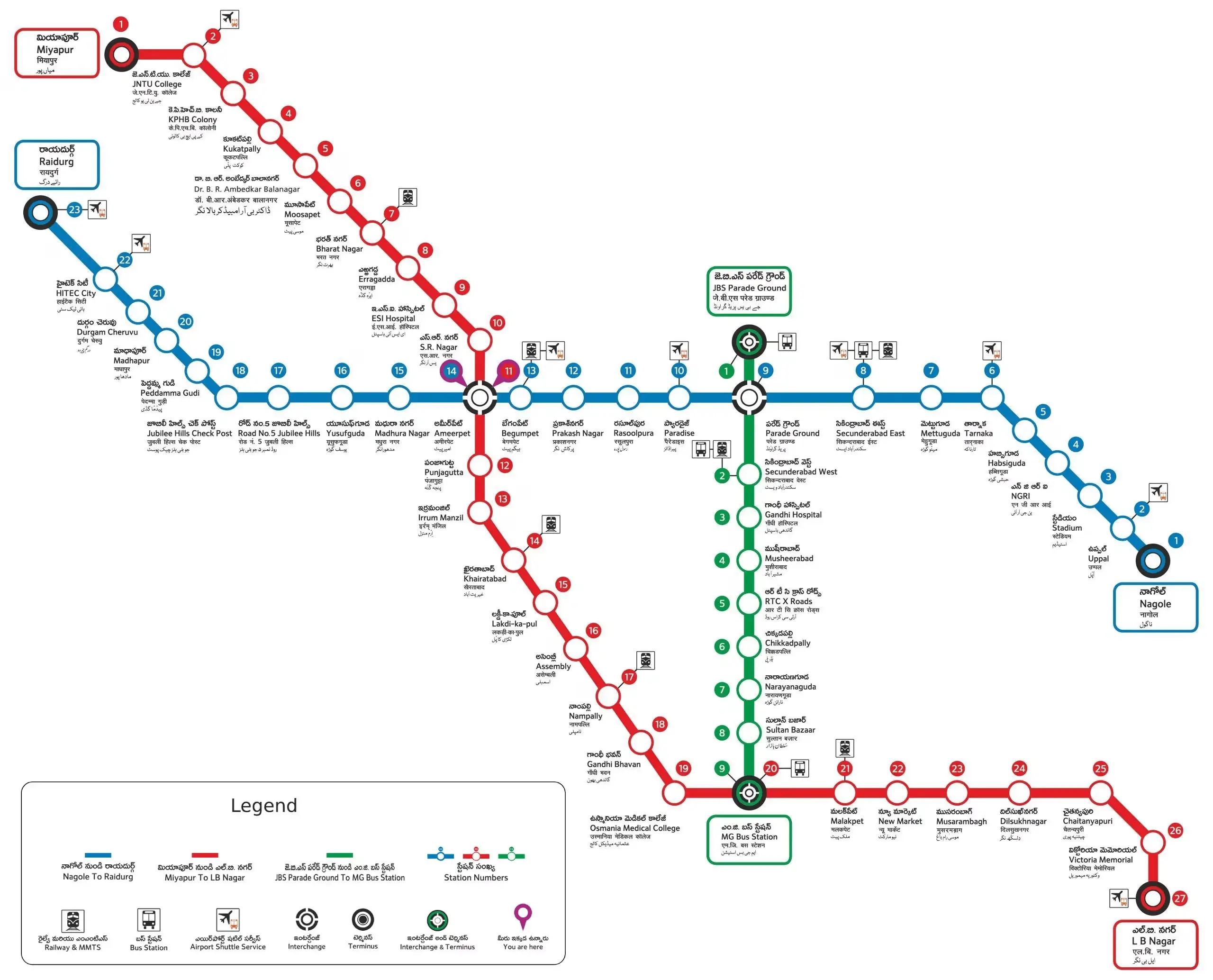
The Hyderabad Metro Rail Project was inaugurated by Prime Minister Narendra Modi on 28 November 2017. It is the world's largest public-private partnership (PPP) project in the metro rail sector. The network spans over 69 km with three lines: Red (Miyapur-LB Nagar), Blue (Nagole-Raidurg), and Green (JBS-MGBS). The system is designed to handle over 1.7 million passengers daily, significantly reducing traffic congestion in the city.
Commuter Tips for Hyderabad Metro Network
Hyderabad Metro operates from 6:00 AM to 11:00 PM daily with trains every 3–8 minutes during peak hours. The Nebulla Smart Card is the most economical way to travel — it automatically deducts the exact fare and gives a 10% discount on every trip. Cards can be recharged online, at station counters, or at designated kiosks spread across the city.
One of Hyderabad Metro's unique features is its co-location with major commercial centres. The stations at HITECH City, Ameerpet, and MGBS are directly integrated with premium malls and transit hubs, allowing effortless transfers between rail and other services. The Red Line corridor (Miyapur–LB Nagar) is the busiest, particularly in the morning peak as IT employees commute toward HITEC City via the Blue Line.
For tourists, the Metro is the best way to experience the twin cities of Hyderabad and Secunderabad. The Charminar and Laad Bazaar are a short autorickshaw ride from MGBS station. Golconda Fort is accessible via feeder services from Ameerpet. Security checks at station entry are thorough but efficient — keep your bags organised to speed through.
Hyderabad Metro Connectivity Guide
Hyderabad Metro's three corridors (Red, Blue, Green) intersect at Ameerpet (Red-Blue interchange) and Parade Ground / MGBS (Blue-Green and Red-Green interchanges). The network is designed so no commuter in metro-served areas needs more than one interchange to reach any part of the city. TSRTC city buses and MMTS suburban trains supplement the metro at several key nodes.
The metro is directly integrated with the Rajiv Gandhi International Airport via express cab services from Raidurg station on the Blue Line. Plans exist for a dedicated Airport Metro Line in the future. For last-mile connectivity, auto-rickshaws and MMR (dial-a-bus) services operate from all stations. Parking facilities at Miyapur, KPHB Colony, Nagole, and Raidurg allow Park & Ride commuters to save fuel while using the metro for the urban leg.
Feeder Bus Connectivity
Key stations with feeder bus services:
- Miyapur
- JNTU College
- KPHB Colony
- Tarnaka
- Secunderabad East
Parking Facilities
Stations with authorized parking:
- Miyapur
- KPHB Colony
- Ameerpet
- Nagole
- Raidurg
- JBS Parade Ground
Network Evolution & Future Plans
Phase II of the Hyderabad Metro will extend corridors to RGIA Airport, Shamshabad, Kokapet, and further into Cyberabad. The proposed extensions will increase the network from 69 km to over 160 km when fully complete. New station designs in Phase II prioritise green building certification, solar energy, and rainwater harvesting. The Hyderabad Metro continues to be operated as the world's largest PPP metro project, a model being studied by several emerging economies for metro financing and construction.